
Toma-Jin Morikawa-Fouquet publishes new article "Pan-Farmerism in Transwar Rural Japan, 1905–1928"
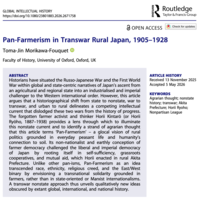
We’ve heard of Pan-Asianism, but what about Pan-Farmerism?
Toma-Jin Morikawa-Fouquet, a graduate of the MSc programme in Japanese Studies and current DPhil candidate in History, recently published an open-access article in Global Intellectual History. It presents a “transwar nonstate approach” to uncover a neglected agrarian strand of thought in early twentieth-century rural Japan: one that posited a non-nationalist vision of peace grounded in transnational farmer solidarity and the reaffirmation of humanity’s connection with nature, especially the soil.
The article problematises the centring of nation-states and empires in narratives of global, international, and national history. By shifting the focus from war to transwar and from state to nonstate, it brings into view obscured practices of worldmaking that sought to liberate people—in this case, farmers—from the spatial and temporal worlds of imperial states. Historical and historiographical narratives centred on imperialism, nationalism, internationalism, and capitalism are thereby dislodged, creating space for alternative constructions of spatiality and temporality.
This archive-based case study of the neglected farmer-intellectual Horii Ryōho (1887–1938) and his networks demonstrates the kind of history that emerges through a transwar nonstate approach to the First World War. More broadly, this methodology can help historians excavate other nonstate currents in different periods and regions of the world.
Read the abstract and full article here.

