

Dr Yosuke Buchmeier publishes new book chapter "Media Freedom in Japan"
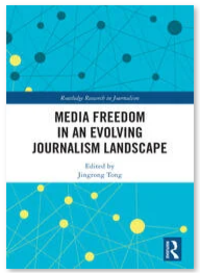
The chapter "Media Freedom in Japan: Institutional Resilience, Democratic Stability, and Digital Disruption" appears in the newly published Routledge volume Media Freedom in an Evolving Journalism Landscape, edited by Jingrong Tong (University of Sheffield), which brings together an international team of scholars and practitioners to examine changes, continuities, and emerging threats to media freedom across the evolving journalistic sphere.
The chapter examines the paradox at the heart of Japan's media system, where formally guaranteed press freedoms coexist with entrenched structural constraints such as the kisha (press club) system, the absence of an independent regulator, and close ties between media, politics, and business. Buchmeier argues that these cooperative institutional arrangements, while limiting genuine pluralism within the mainstream, have also made Japanese media remarkably resilient — sustaining comparatively high public trust in mainstream outlets, particularly the public broadcaster NHK, and helping to shield the country from the polarisation and fragmentation affecting news ecosystems elsewhere. Yet, as the chapter shows, digital disruption now poses new and potentially destabilising challenges, making Japan a distinctive case for understanding how historical resilience, cooperative institutional arrangements, and structural inertia interact with the transformative pressures of digital media in a mature democracy — with ambiguous implications for the future of media freedom.
The chapter, by Dr Yosuke Buchmeier, is published in Media Freedom in an Evolving Journalism Landscape (Routledge, 2026) and is available here.

